Machine Learning with Pytorch and Scikit-Learn
Buy the bookAs an Amazon Associate I earn from qualifying purchases.
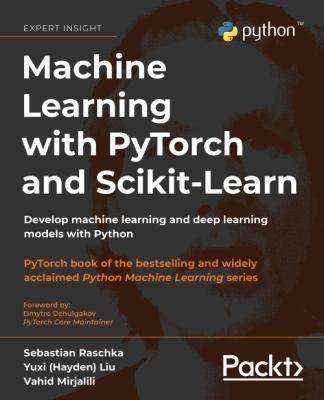
A broad Python ML textbook covering classical methods, deep learning, transformers, graph networks and reinforcement learning.
What it covers
The publisher’s numbered chapters move from classification, regression, clustering, preprocessing and model evaluation into PyTorch neural networks, CNNs, sequence models, transformers, GANs, graph neural networks and reinforcement learning. This is a broad machine-learning/deep-learning textbook, not only a guide to classification or data shaping.
Why it matters
It suits Python developers and data scientists who want foundations and worked implementations across classical and deep learning. The publisher expects familiarity with Python, calculus and linear algebra. Its February 2022 first edition should not be presented as a current agent-framework manual.
What it made me think
Choose the chapter that matches the task: regression, clustering, a neural architecture or a learning agent. Then reproduce its example and evaluate the method on held-out data rather than substituting a general story about model size.
The short version
A foundations shelf should say which foundations a book actually teaches.
My take
For a Python reader, I would choose a chapter that matches the next modeling task and work through its example before adapting it. The value is the combination of foundations and implementation practice; the 2022 first edition is a learning reference rather than a guide to current agent frameworks.
How it connects
- Classical methods and neural networks
- Architecture-specific worked examples
- Evaluation and reader prerequisites
Bottom line
Use the contents and prerequisites to choose a chapter for the actual learning task.
Takeaways
- Classical ML and deep learning receive substantial coverage.
- PyTorch chapters include CNNs, sequence modeling, transformers and GANs.
- Graph neural networks and reinforcement learning are separate topics.
- Use the publisher’s prerequisites to judge fit.
- The 2022 first edition is foundational reading, not evidence of a 2026 agent deployment.
Brendon Score: 8.3/10
- Relevance: 8.0/10 — +2.00
- Depth: 9.0/10 — +2.25
- Actionability: 9.0/10 — +2.25
- Freshness: 7.0/10 — +1.75
- Average: 8.25
- Total (rounded): 8.3/10
As an Amazon Associate I earn from qualifying purchases.
Why this is here
Checks cleared: theme-relevance, llm-commentary-only (shortlist scoring unavailable).